

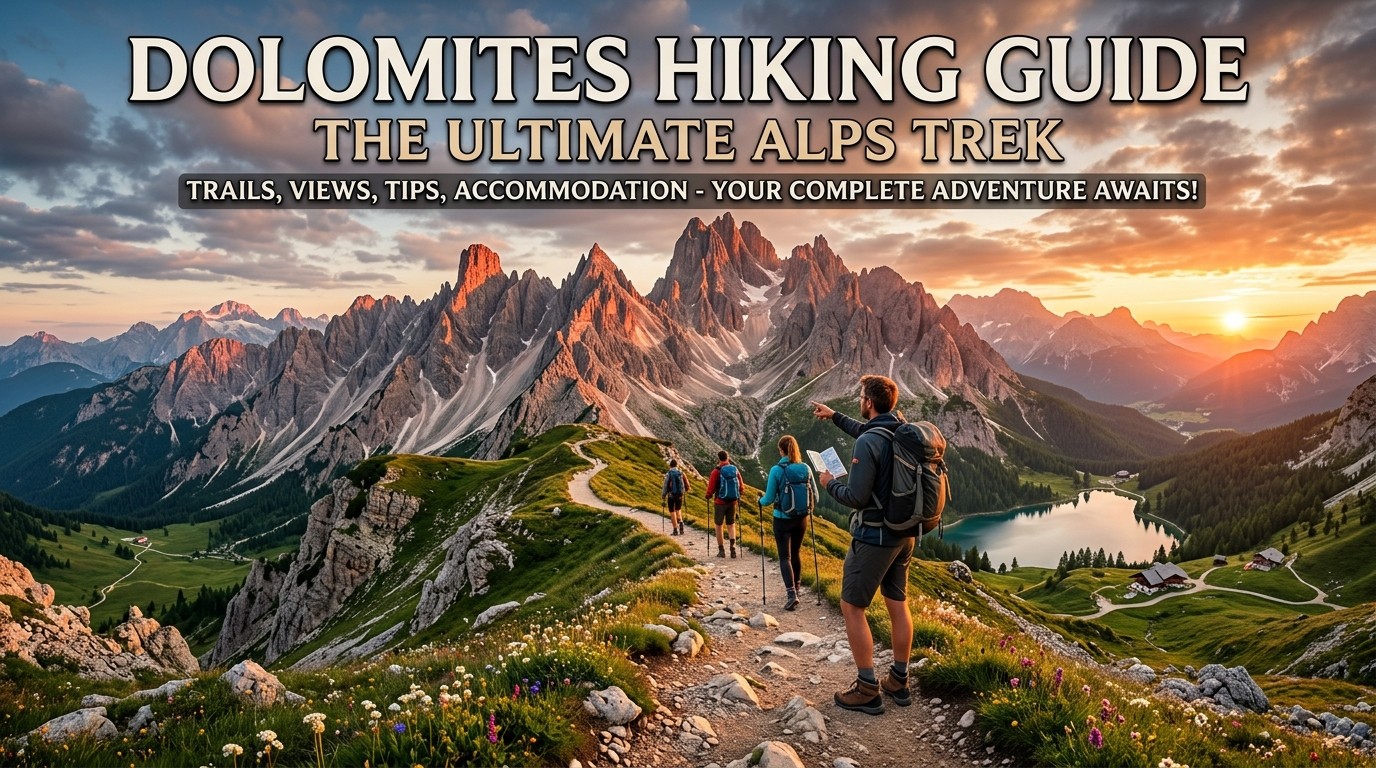
Dolomites Hiking combines dramatic limestone peaks, alpine villages, mountain huts, and spectacular trails into one of Europe’s most rewarding outdoor adventures for prepared travelers.
Dolomites Hiking is more than walking through beautiful mountains. It is an experience built around dramatic scenery, physical movement, alpine culture, quiet mornings, mountain huts, changing weather, and the satisfaction of reaching a viewpoint under your own power. The Dolomites form a UNESCO World Heritage property in northern Italy covering 141,903 hectares, with 18 peaks rising above 3,000 metres and landscapes defined by vertical walls, pinnacles, cliffs, deep valleys, and distinctive geological formations. UNESCO also notes that the area is shaped by dynamic natural processes, including landslides, floods, and avalanches, which is why preparation matters as much as enthusiasm.
For a first-time visitor, Dolomites Hiking can look deceptively easy because cable cars, mountain roads, scenic villages, and well-known viewpoints make access surprisingly convenient in many areas. But easy access does not mean every trail is easy. Some routes are gentle walks through alpine meadows, while others involve steep ascents, exposed terrain, loose rock, or long days at elevation.
The smartest approach is to match the trail to your fitness, experience, weather conditions, and confidence level. Dolomites Hiking becomes significantly more enjoyable when you stop thinking about collecting kilometers and start thinking about creating a complete mountain experience.
That means selecting the right base, understanding transportation, knowing where mountain huts fit into your plan, carrying the right equipment, and leaving enough flexibility for changing conditions.
Why Dolomites Hiking Is So Special
Dolomites Hiking feels different because the mountains are visually dramatic almost everywhere you look. The scenery combines pale limestone towers with green meadows, deep valleys, forests, cliffs, and high alpine terrain.
UNESCO describes the Dolomites as one of the world’s most significant mountain landscapes and emphasizes their exceptional natural beauty and geological importance.
But photographs only capture part of the experience.
The other part is movement.
You start walking through a forest.
Then the trees thin.
A meadow opens.
A mountain wall appears.
A trail curves around a ridge.
A hut appears in the distance.
And suddenly the landscape feels much larger than it looked on a map.
This progression creates a psychological reward that is hard to reproduce in a car-based sightseeing trip.
Dolomites Hiking and the Human Psychology of Adventure
One reason Dolomites Hiking can feel so memorable is that walking creates a different relationship with distance.
In a car, a kilometer disappears quickly.
On foot, you experience it.
You feel the climb.
You notice the weather.
You hear the wind.
You watch shadows move across the mountains.
That slower pace forces attention.
For many travelers, this is one of the most attractive parts of Dolomites Hiking. The journey becomes an active experience rather than transportation between attractions.
There is also a confidence effect.
Each successful climb gives you evidence that you can handle more than you initially expected.
That does not mean pushing beyond your limits.
In fact, good mountain judgment often means turning around.
Real confidence comes from knowing the difference between challenging yourself and creating unnecessary danger.
Choosing Your Dolomites Hiking Style
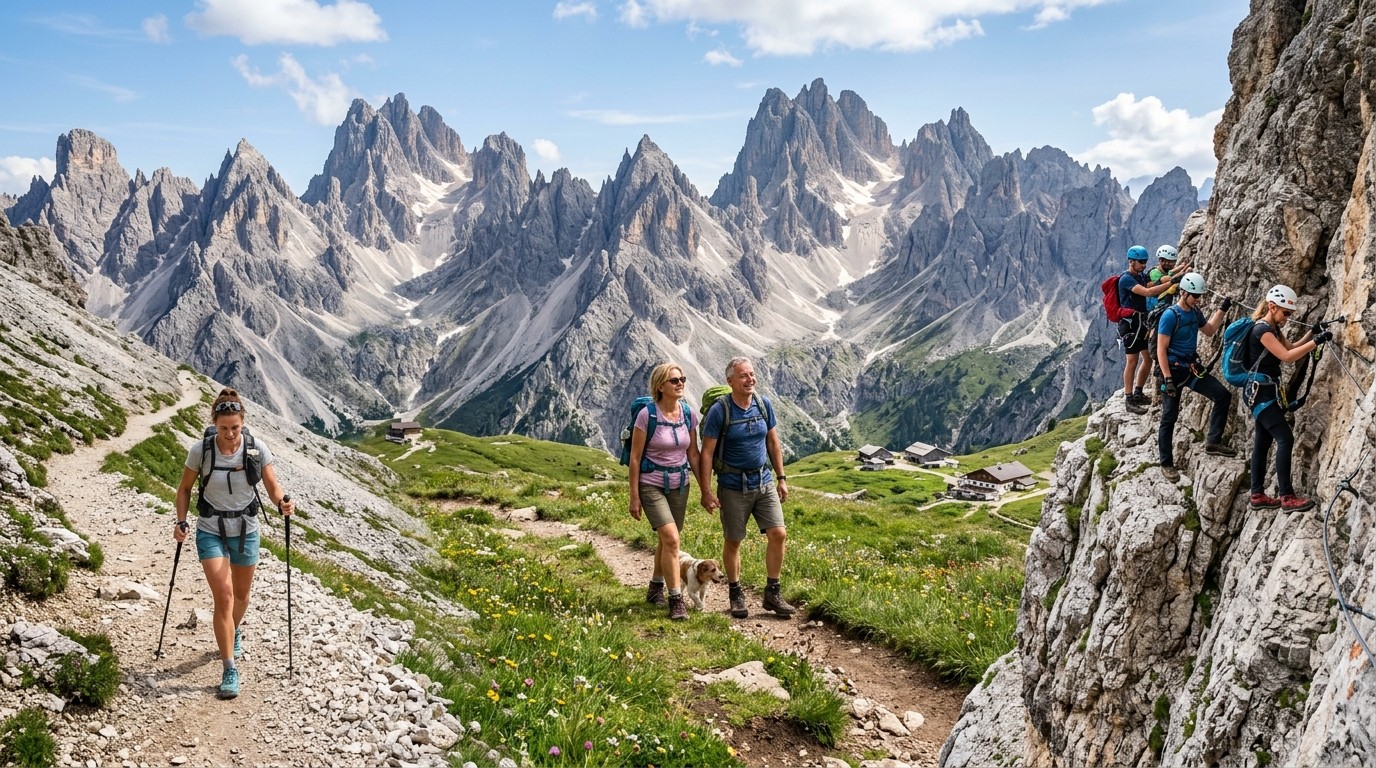
There is no single correct way to experience the mountains.
Your itinerary should depend on your physical ability, available time, appetite for adventure, and preferred comfort level.
| Hiking Style | Typical Experience | Best For |
|---|---|---|
| Scenic walks | Shorter routes with major viewpoints | Beginners |
| Day hikes | Several hours on established trails | Most travelers |
| Multi-day hut trek | Consecutive hiking days with hut stays | Experienced hikers |
| Alta Via routes | Long-distance mountain trekking | Strong hikers |
| Lift-assisted hiking | Cable car ascent + hiking | Flexible travelers |
| Guided mountain routes | Expert support and route knowledge | Technical terrain |
Dolomites Hiking works particularly well because you can combine these styles.
You might spend one day on an easy scenic route, another day on a longer hike, and another day using a lift to access higher terrain.
That flexibility makes the region accessible to many different travelers.
Best Areas for Dolomites Hiking
The Dolomites are not one single hiking destination.
They are a huge mountain region spread across different valleys and communities.
That means location matters.
Alta Badia
Alta Badia is particularly attractive for travelers who want a combination of hiking, villages, mountain huts, food, and strong mountain infrastructure.
The official Alta Badia tourism site currently lists a large network of accommodations and highlights villages including Corvara, Colfosco, La Villa, San Cassiano, Badia, and La Val.
The region also has an extensive mountain-hut culture.
The official tourism organization describes mountain huts as popular destinations for hikers and emphasizes traditional Ladin, Italian, and South Tyrolean food served in alpine settings.
This creates an excellent rhythm:
Hike.
Rest.
Eat.
Watch the mountains.
Sleep.
Repeat.
Cortina d’Ampezzo
Cortina is another major base for Dolomites Hiking.
It is particularly attractive if you want access to iconic peaks, scenic trails, mountain infrastructure, restaurants, and a more developed resort atmosphere.
Cortina can also work well as part of a larger itinerary that connects multiple areas of the Dolomites.
Val Gardena
Val Gardena is known for spectacular mountain scenery and extensive trail options.
It can be particularly appealing to travelers who want a combination of hiking, cable cars, mountain huts, and established alpine villages.
Alta Via routes
For more experienced hikers, long-distance routes such as Alta Via 1 provide a completely different experience.
The official Alta Badia tourism information identifies Alta Via delle Dolomiti No. 1 as a classic route running from Lago di Braies toward Belluno, approximately 130 kilometres long and typically completed over 10 to 13 days with alpine-hut accommodation.
That is not a casual vacation hike.
It requires preparation.
But it demonstrates how extensive the region’s trekking possibilities are.
How Many Days Do You Need?
Three days can introduce you to the mountains.
Five to seven days allows a much deeper experience.
Ten or more days can support a multi-area or long-distance itinerary.
For first-time Dolomites Hiking, five to seven days is often an excellent balance.
You can choose one base and explore gradually.
A simple week might look like:
Day 1
Arrival and village exploration.
Day 2
Easy scenic hike.
Day 3
Longer mountain route.
Day 4
Recovery day or lift-assisted walk.
Day 5
Major panoramic hike.
Day 6
Another valley or hut experience.
Day 7
Relaxed final walk and departure.
The important idea is not to fill every day with maximum effort.
Why Recovery Days Matter
Mountain travelers often underestimate fatigue.
You may feel excellent after the first day.
Then you wake up on day three and realize your legs are tired.
Dolomites Hiking is more enjoyable when the itinerary includes different intensity levels.
A recovery day can include:
- village walking
- mountain-hut lunch
- scenic cable-car ride
- easy lakeside walk
- local food
- photography
- relaxation
The goal is to return home feeling stronger rather than completely exhausted.
Using Cable Cars Intelligently
Cable cars are one of the major reasons Dolomites Hiking can work for such a broad range of travelers.
They allow you to reach high elevations without walking every meter from valley level.
The official Alta Badia Summer Card page currently lists summer 2026 access options for the region’s lift network and describes the lifts as a way to reach mountain areas while reducing dependence on cars.
This is useful for travelers who want dramatic scenery without committing to an extremely long ascent.
A lift-assisted hike can look like:
Cable car up.
High-altitude trail.
Mountain-hut lunch.
Panoramic descent.
Return to the village.
That can still feel like a serious mountain day without requiring an expedition-level effort.
Check individual lift operating dates before departure because summer opening periods vary by location and season. Current 2026 information shows lift operations extending across multiple areas from spring into autumn.
Dolomites Hiking and Mountain Huts
Mountain huts are one of the defining features of the region.
They change the nature of trekking.
Instead of hiking back to the valley after every route, you can sometimes stay overnight at altitude.
That allows you to see:
- sunrise above the peaks
- sunset from the mountains
- quieter trails
- early-morning landscapes
- alpine food
- traditional mountain hospitality
Alta Badia currently lists numerous mountain huts with different opening periods throughout the 2026 season, illustrating why checking exact dates is important when building a hut-to-hut route.
Do not assume every hut operates year-round.
Opening dates vary.
Some are open only during particular summer months.
Some routes depend on lifts or seasonal access.
Always confirm directly before building your itinerary around a hut.
What Is It Like to Sleep in a Mountain Hut?
The experience is social.
You may arrive alone and leave with new hiking companions.
Dormitory accommodation can be simple.
Meals may be communal.
The atmosphere tends to be different from hotels.
That is part of the attraction.
Dolomites Hiking becomes more memorable when the mountain itself becomes your accommodation for the night.
But hut travel requires flexibility.
You should know the basic rules before arrival.
Carry a headlamp.
Bring appropriate sleeping equipment if required.
Confirm payment arrangements.
Check food availability.
Understand arrival times.
And never assume a reservation exists simply because you sent an inquiry.
Planning a Hut-to-Hut Route
Start with the route.
Then identify the huts.
Then check whether the huts are open.
Then confirm availability.
Only after those steps should you finalize the itinerary.
This sounds obvious, but many travelers do the opposite.
They book flights first.
Then hotels.
Then discover that the ideal hut is full.
That can destroy a carefully planned route.
For long-distance Dolomites Hiking, accommodation availability can become one of the biggest constraints.
What to Pack
The mountains reward practical packing.
Your essentials should include:
- hiking shoes or boots suited to the route
- moisture-managing layers
- waterproof shell
- insulating layer
- comfortable hiking socks
- sun protection
- water capacity
- snacks
- basic first-aid supplies
- navigation tools
- headlamp
- power bank
- personal medication
- emergency contacts
You should adjust the list based on season, route, altitude, and accommodation.
A day hike and a 10-day hut trek are not the same packing problem.
Shoes Matter More Than Fashion
A beautiful shoe that causes blisters is useless.
Prioritize:
- grip
- stability
- comfort
- fit
- durability
Break new shoes in before the trip.
Do not arrive in the Alps with brand-new footwear and expect your feet to adapt overnight.
Foot problems are among the easiest ways to turn an exciting hiking holiday into an uncomfortable one.
Weather and Conditions
The Dolomites are mountainous terrain.
Weather can change quickly.
Rain can transform trail conditions.
Cloud can reduce visibility.
Temperatures can change rapidly with elevation.
And geological hazards exist.
UNESCO specifically notes that the Dolomites experience dynamic processes including frequent landslides, floods, and avalanches.
That does not mean you should be afraid.
It means you should respect the environment.
Check local conditions.
Ask local tourism offices.
Use official trail information.
And change your route when conditions demand it.
Trail Etiquette
The mountains are shared spaces.
Respect other hikers.
Do not blast music from speakers.
Keep dogs controlled according to local rules.
Stay on designated routes.
Take all waste with you.
Do not pick alpine flowers.
Do not disturb wildlife.
The Alta Badia tourism organization specifically advises visitors to respect local culture, protect nature, carry waste back to the valley, avoid fires, avoid picking flowers, and avoid disturbing wildlife.
These rules protect the landscape that makes Dolomites Hiking special in the first place.
Solo Dolomites Hiking
Solo hiking can be deeply rewarding.
It allows you to control your pace.
You can stop whenever you want.
You can take photographs without worrying about someone else.
You can walk quietly for hours.
But solo hiking requires better preparation.
Tell someone your route.
Carry communication equipment.
Understand the route before starting.
Know the weather.
Avoid unnecessary exposure.
And know when to turn around.
The official Alta Badia tourism site highlights tourist offices in multiple local communities, including Corvara, Colfosco, La Villa, San Cassiano, Badia, and La Val, which can be useful resources for local information.
Solo Travel Hawaii as a Comparison
Solo Travel Hawaii may seem very different from Dolomites Hiking, but there is an important similarity.
Both reward travelers who understand nature rather than simply consume scenery.
In Hawaiʻi, weather, ocean conditions, volcanic terrain, and trail safety matter.
In the Dolomites, elevation, rock, weather, trail exposure, and mountain conditions matter.
The broader lesson is that nature-based travel demands humility.
Beautiful landscapes are not automatically safe landscapes.
USA Solo Travel as Another Comparison
USA Solo Travel demonstrates how outdoor travel can combine independence with infrastructure.
A U.S. road trip may give you more control over transportation.
Dolomites Hiking often gives you more control over your walking pace.
Both reward travelers who plan their days around geography.
Both punish unrealistic schedules.
Both are better when you leave space for weather and unexpected discoveries.
Inca Trail Trek Versus Dolomites Hiking
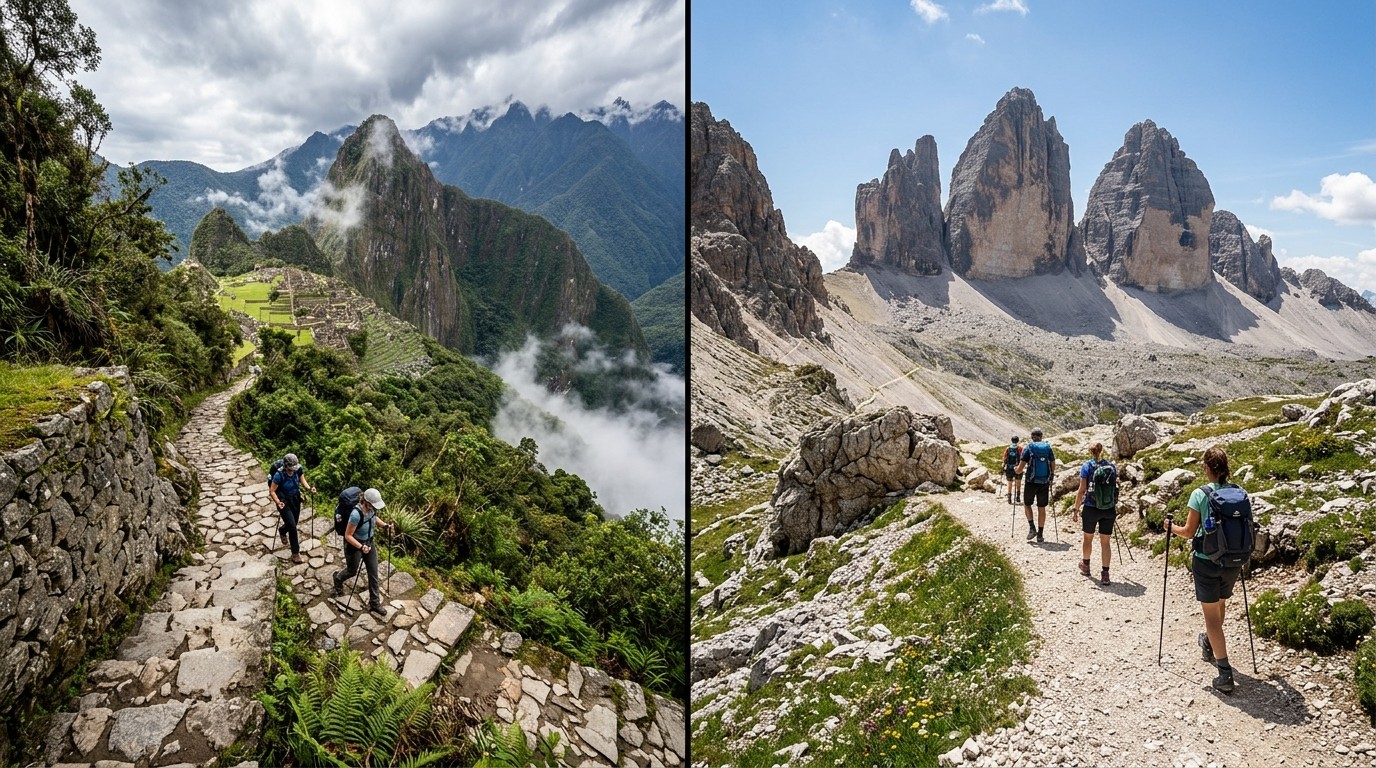
The Inca Trail Trek is a specific cultural and trekking experience in Peru.
Dolomites Hiking offers an entire mountain region with a much broader variety of routes.
The Inca Trail emphasizes the journey toward a globally recognized archaeological destination.
The Dolomites emphasize mountain landscapes, alpine culture, hut systems, geological drama, and route variety.
Neither is objectively better.
They simply represent different forms of adventure.
If you want history woven tightly into the trek, the Inca Trail has a strong advantage.
If you want to explore different mountain routes over several days, the Dolomites offer enormous flexibility.
Physical Preparation
Start training several weeks before your trip.
You do not need to run ultramarathons.
Focus on:
Walking endurance
Long walks gradually increase your ability to remain active.
Incline training
Stairs or hill walking prepare your legs for elevation gain.
Strength
Squats, lunges, step-ups, and core work can help.
Downhill control
Descending is often underestimated.
Your knees may experience more stress going downhill than expected.
Backpack adaptation
Train with the approximate weight you will carry.
That lets you identify problems before reaching Italy.
How to Choose a Route
Do not choose the famous route simply because it appears in every photograph.
Ask:
How many hours can I comfortably hike?
How much elevation gain can I manage?
Am I comfortable with exposure?
Do I need cable-car assistance?
Do I prefer a loop or point-to-point route?
Do I need hut accommodation?
What happens if the weather changes?
The best Dolomites Hiking route is the one that matches your current ability.
Not the one that looks most impressive online.
Building a First-Timer Itinerary
For a first experience, consider a base-and-day-hike approach.
Stay in one village.
Take day hikes.
Use lifts where useful.
Return to the same accommodation.
This eliminates the complexity of carrying everything between huts.
Once you understand how the terrain feels, you can return for a longer hut-to-hut itinerary.
This approach is psychologically useful because it reduces the fear of making mistakes.
You have a fixed base.
You can ask local professionals for advice.
You can modify routes each morning.
You can recover properly.
A Seven-Day Example
Day 1
Arrive in your chosen valley.
Explore the village.
Check equipment.
Confirm weather.
Day 2
Easy hike.
Focus on understanding pace.
Day 3
Longer panoramic route.
Mountain-hut lunch.
Day 4
Recovery.
Short walk or lift-assisted outing.
Day 5
Major hiking day.
Start early.
Day 6
Alternative valley or cultural experience.
Day 7
Short final route.
Depart.
The exact route should depend on current trail conditions.
Using Local Infrastructure
One of the advantages of Dolomites Hiking is the amount of mountain infrastructure available in many areas.
Lift systems can help with access.
Mountain huts provide food and accommodation.
Tourist offices can provide local information.
Villages provide transportation and supplies.
Alta Badia’s tourism network currently provides tourist information offices throughout its major communities, offering a useful local resource for visitors.
Use local knowledge.
A local recommendation about today’s conditions may be more valuable than an old online itinerary.
Food as Part of the Hiking Experience
Mountain food is part of the culture.
In Alta Badia, official tourism information highlights Ladin, Italian, and South Tyrolean dishes in mountain huts, ranging from simple snacks to traditional meals and more elaborate cuisine.
That means lunch does not need to be something you rush through.
A hut meal can become part of the destination.
Stop.
Eat.
Look at the mountains.
Let yourself recover.
Then continue.
How to Photograph the Dolomites
The Dolomites are exceptionally photogenic.
But the best images often come from patience.
Early morning light can be soft.
Late afternoon can create dramatic shadows.
Cloud can add depth.
Fog can completely transform a familiar mountain.
Do not spend the entire hike looking through your phone.
Take photographs.
Then put the camera away.
The landscape is better when experienced directly.
Responsible Drone and Camera Use
Always check local regulations before flying drones.
Do not disturb wildlife.
Do not interfere with other hikers.
And remember that some of the most meaningful images require no complicated equipment.
A phone camera can capture an emotional moment perfectly well.
The goal is memory.
Not equipment.
Sustainable Dolomites Hiking
The Dolomites are not simply a tourism product.
They are a living landscape.
UNESCO’s designation emphasizes the geological and natural significance of the area, while regional tourism organizations increasingly highlight sustainable mobility and responsible mountain behavior. Alta Badia, for example, promotes public transportation and sustainable alternatives as part of moving around the mountains.
Choose shared transportation where practical.
Use lifts responsibly.
Stay on marked routes.
Support local businesses.
Respect villages.
Eat local food.
Keep waste with you.
Sustainability is not about making your trip less enjoyable.
It is about making sure the landscape remains enjoyable for future travelers.
When to Visit
Summer is generally the core hiking period, but exact accessibility varies by elevation, route, lift, hut, and weather.
Current 2026 information from Dolomiti SuperSummer describes lift operations across parts of the Dolomites from May into November, while individual facilities and huts have their own opening periods.
That means you should never rely on a generic statement such as “everything opens in June.”
Check the exact route.
Check the exact lift.
Check the exact hut.
Check the exact date.
Budget Planning
Your budget will depend on whether you choose:
- hotel-based day hiking
- guesthouses
- apartments
- hut-to-hut trekking
- guided routes
- lift-assisted hiking
- rental car travel
Accommodation varies widely.
Alta Badia’s official accommodation directory currently lists hundreds of properties across different categories, including hotels, apartments, guesthouses, farm stays, and bed-and-breakfast options.
This means you can create very different versions of the same trip.
A budget traveler might use a guesthouse and public transportation.
A comfort-focused traveler might choose a hotel with mountain views.
A trekker might prioritize mountain huts.
A Smart Booking Strategy
Book the most constrained elements first.
For a day-hike trip:
- Accommodation
- Transport
- Major activities
- Lifts where necessary
- Restaurant reservations if important
For hut-to-hut:
- Route
- Hut availability
- Transportation
- Backup accommodation
- Remaining logistics
Do not build a ten-day mountain route before confirming that the places you need to sleep actually have space.
Common Mistakes
Mistake 1: Trying to do too much
The Dolomites look close together on a map.
Mountains change that perception.
Mistake 2: Ignoring elevation
Distance alone does not determine difficulty.
Mistake 3: Underestimating downhill hiking
Descending can be physically demanding.
Mistake 4: Relying entirely on online information
Conditions change.
Mistake 5: Bringing unsuitable shoes
Foot discomfort can ruin the trip.
Mistake 6: Ignoring weather
Clear skies are not guaranteed.
Mistake 7: Overpacking
A heavy pack reduces enjoyment.
Mistake 8: Treating cable cars as guaranteed
Check opening schedules.
Mistake 9: Forgetting recovery
Your body needs time to adapt.
Mistake 10: Chasing photographs instead of experiences
The mountain is more important than the post.
The Mental Model for a Great Trek
A great hiking trip has three layers.
Physical
Your body must be capable of the route.
Practical
Your transport, accommodation, equipment, and weather plans must work.
Psychological
You must be comfortable adapting when reality differs from the itinerary.
That third layer is often ignored.
But it is incredibly important.
The mountain does not care what your spreadsheet says.
A great Dolomites Hiking experience happens when planning creates confidence without eliminating flexibility.
Final Packing Framework
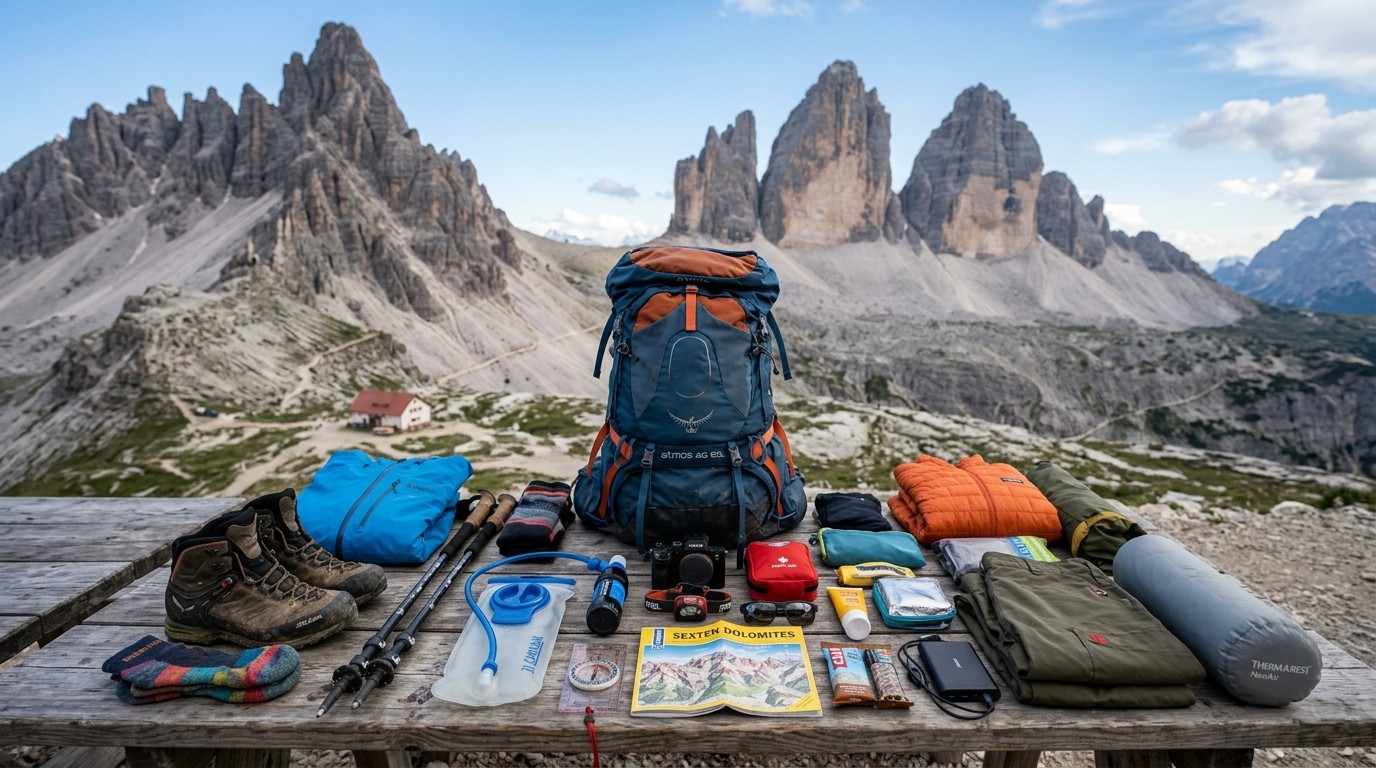
Clothing
Layering system.
Moisture management.
Rain protection.
Warm insulation.
Footwear
Proper hiking shoes or boots.
Backup socks.
Navigation
Phone.
Offline maps.
Backup navigation.
Safety
First aid.
Headlamp.
Emergency communication.
Hydration and food
Enough water.
Energy-rich snacks.
Accommodation
Reservation details.
Payment method.
Necessary hut equipment.
Personal
Medication.
Identification.
Insurance information.
Emergency contacts.
Conclusion
Dolomites Hiking offers one of the most complete alpine travel experiences in Europe because the region combines extraordinary geology, dramatic scenery, accessible mountain infrastructure, traditional villages, alpine huts, and routes ranging from gentle walks to demanding multi-day treks. The key to enjoying it is preparation without overplanning. Choose a route that matches your fitness, check current trail and lift conditions, confirm hut availability, pack for changing weather, and leave enough time for rest and unexpected discoveries. Whether you base yourself in Alta Badia, explore near Cortina, use lifts to reach higher trails, or eventually attempt a long-distance route, the mountains reward patience. Respect the landscape, move intelligently, and let the scenery determine the pace of the journey.
Frequently Asked Questions (FAQ)
1. Is Dolomites Hiking suitable for beginners?
Yes. The region has a wide range of routes, including easier walks and lift-assisted hikes. Beginners should choose routes based on actual ability rather than dramatic photographs.
2. How many days should I spend hiking in the Dolomites?
Five to seven days is a strong starting point. Experienced trekkers may want ten days or longer for a multi-day route.
3. What is the best area for a first trip?
Alta Badia, Cortina d’Ampezzo, and Val Gardena are useful bases because they provide access to substantial hiking infrastructure and mountain communities.
4. Can I do Dolomites Hiking without a car?
Yes. Depending on the base and itinerary, public transport, lifts, and local connections can reduce the need for a rental car. Alta Badia specifically promotes sustainable mobility and lift access.
5. Are mountain huts open all year?
No. Opening periods vary by hut. Current 2026 Alta Badia listings show different operating windows for individual mountain refuges, so confirm dates directly before booking.
6. What is Alta Via 1?
Alta Via delle Dolomiti No. 1 is a classic long-distance route from Lago di Braies toward Belluno. Alta Badia tourism describes it as approximately 130 kilometres and typically 10 to 13 days with alpine-hut accommodation.
7. Do I need hiking boots?
For more demanding routes, appropriate hiking footwear is highly recommended. The exact choice depends on terrain, weather, route difficulty, and your own foot and ankle needs.
8. Is Dolomites Hiking safe for solo travelers?
It can be, but solo hikers should use more conservative planning, carry appropriate emergency equipment, share their itinerary, and check conditions before departure.
9. Can I combine Dolomites Hiking with other countries?
Yes. Northern Italy connects relatively well with neighboring Alpine destinations, making multi-country itineraries possible if you have enough time.
10. How does Dolomites Hiking compare with the Inca Trail Trek?
The Inca Trail is a specific high-altitude trekking experience linked to Machu Picchu, while the Dolomites offer a broad range of routes, valleys, huts, lifts, and mountain experiences across an extensive UNESCO landscape. UNESCO identifies nine components within the Dolomites World Heritage property.




Leave a Reply