

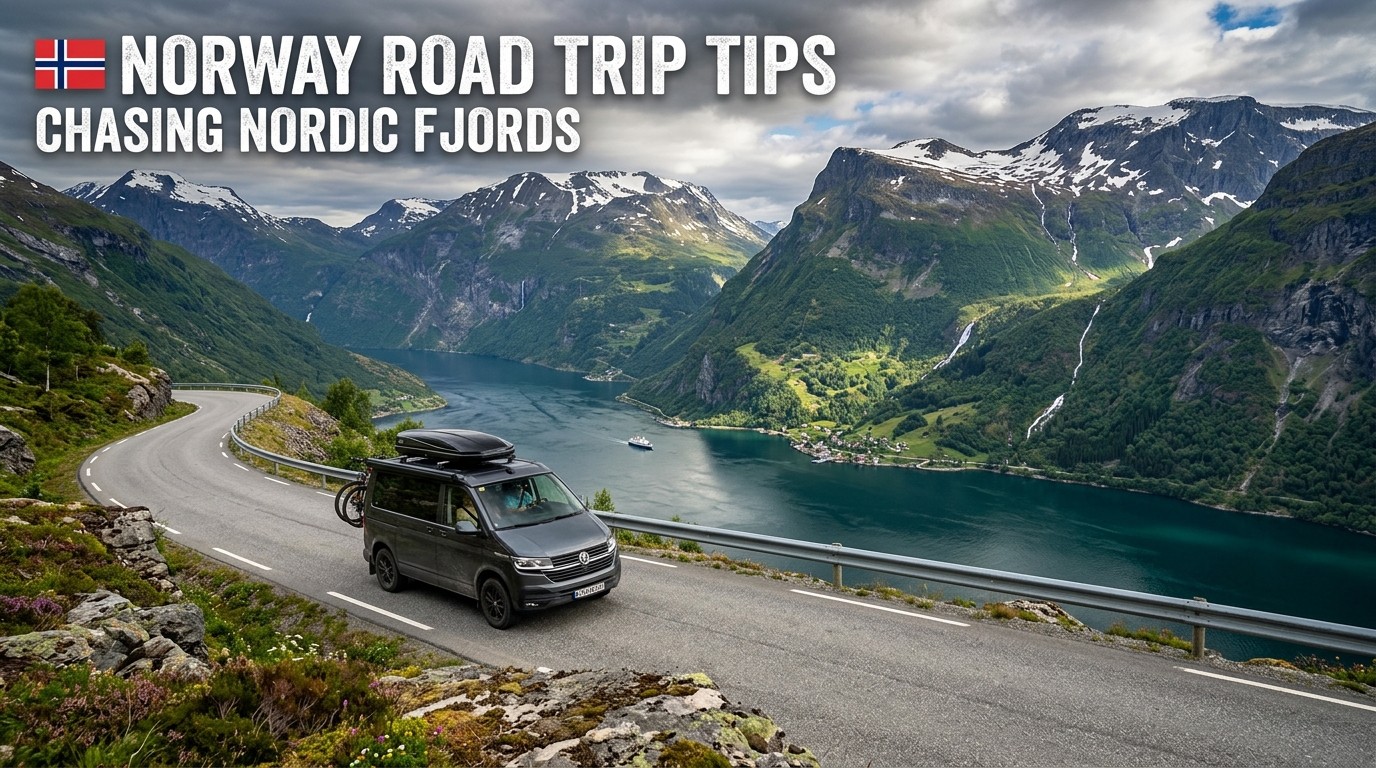
Norway rewards road trippers with dramatic fjords, mountain passes, waterfalls, coastal villages, scenic routes, and unforgettable drives when planning, pacing, and preparation come together.
Norway is not simply a country you drive through; it is a destination where the journey itself becomes one of the main attractions. Roads curve beside deep blue fjords, disappear into mountain tunnels, climb dramatic passes, and suddenly open onto waterfalls, glaciers, fishing villages, and panoramic viewpoints. The experience can feel almost cinematic, but it also requires a different approach to driving than a conventional European city-to-city vacation.
The best Norway Road Trip Tips begin with one simple idea: do not treat every kilometer on the map as equal. A route that looks short geographically may take considerably longer because of narrow roads, ferries, mountain sections, tunnels, photographs stops, weather changes, and slow scenic driving. Official Norwegian tourism guidance specifically warns travelers not to underestimate distances and driving times, particularly on remote roads leading toward fjords.
Norway Road Trip Tips become even more valuable once you realize that the country’s attractions are spread across an enormous landscape. Norway is Europe’s longest country, and the distance from Kristiansand in the south to Hammerfest in the north can require around 30 hours of driving under basic route conditions.
Norway Road Trip Tips should therefore focus less on squeezing destinations into a checklist and more on creating an enjoyable rhythm. Instead of trying to conquer the entire western coast in one week, choose one geographic region and explore it properly.
Norway Road Trip Tips also involve accepting that weather can change your itinerary. A clear morning can become wet, windy, foggy, or snowy as you gain elevation. Mountain passes can be closed during difficult conditions, and official route information should be checked before setting off.
The payoff is enormous. Few travel experiences compare with waking up near a fjord, driving through quiet valleys, stopping at a waterfall, boarding a car ferry, and ending the day in a small village surrounded by mountains.
Norway Road Trip Tips for Choosing the Right Route
The biggest planning mistake is choosing a route based only on the places you recognize from social media. Norway has too many spectacular destinations for that strategy to work efficiently.
Norway Road Trip Tips should start with geography. Divide the country into travel regions rather than building a giant wish list.
For a classic first road trip, Western Norway is usually the most logical focus because the region combines Bergen, Sognefjord, Hardangerfjord, Flåm, Geiranger, Ålesund, mountain roads, waterfalls, and several iconic scenic routes.
Northern Norway creates a completely different experience. Lofoten, Senja, Tromsø, and the coastal landscapes offer dramatic peaks rising directly from the sea, fishing villages, beaches, and long summer daylight.
Southern Norway works well for travelers who prefer a more relaxed combination of coastal scenery, historic towns, forests, lakes, and mountain landscapes.
The key is matching your route to the time available.
Suggested Regional Road-Trip Styles
| Region | Ideal For | Suggested Trip Length | Signature Experience |
|---|---|---|---|
| Western Fjords | First-time visitors | 7–10 days | Fjords, waterfalls, mountain roads |
| Lofoten | Dramatic coastlines | 5–8 days | Fishing villages and sea-to-mountain scenery |
| Southern Norway | Relaxed exploration | 5–7 days | Coast, forests, towns, scenic roads |
| Western + Bergen | Balanced classic trip | 8–12 days | City, fjords, ferries, villages |
| Northern Norway | Adventure travelers | 8–14 days | Arctic landscapes and coastal driving |
Norway Road Trip Tips are particularly useful when deciding whether to travel in a loop or one-way. A loop allows you to return the rental car to the same location and can sometimes simplify logistics, while a one-way route may save hours of backtracking.
Norway Road Trip Tips also suggest avoiding the temptation to start and end in different cities unless the itinerary genuinely benefits from it. One-way rental logistics can involve additional fees, and long transfers may reduce the time available for exploration.
Norway Road Trip Tips should always include buffer time. If your itinerary requires six hours of driving every day, you are building a transportation trip rather than a scenic road trip.
The Best Time for a Norway Road Trip
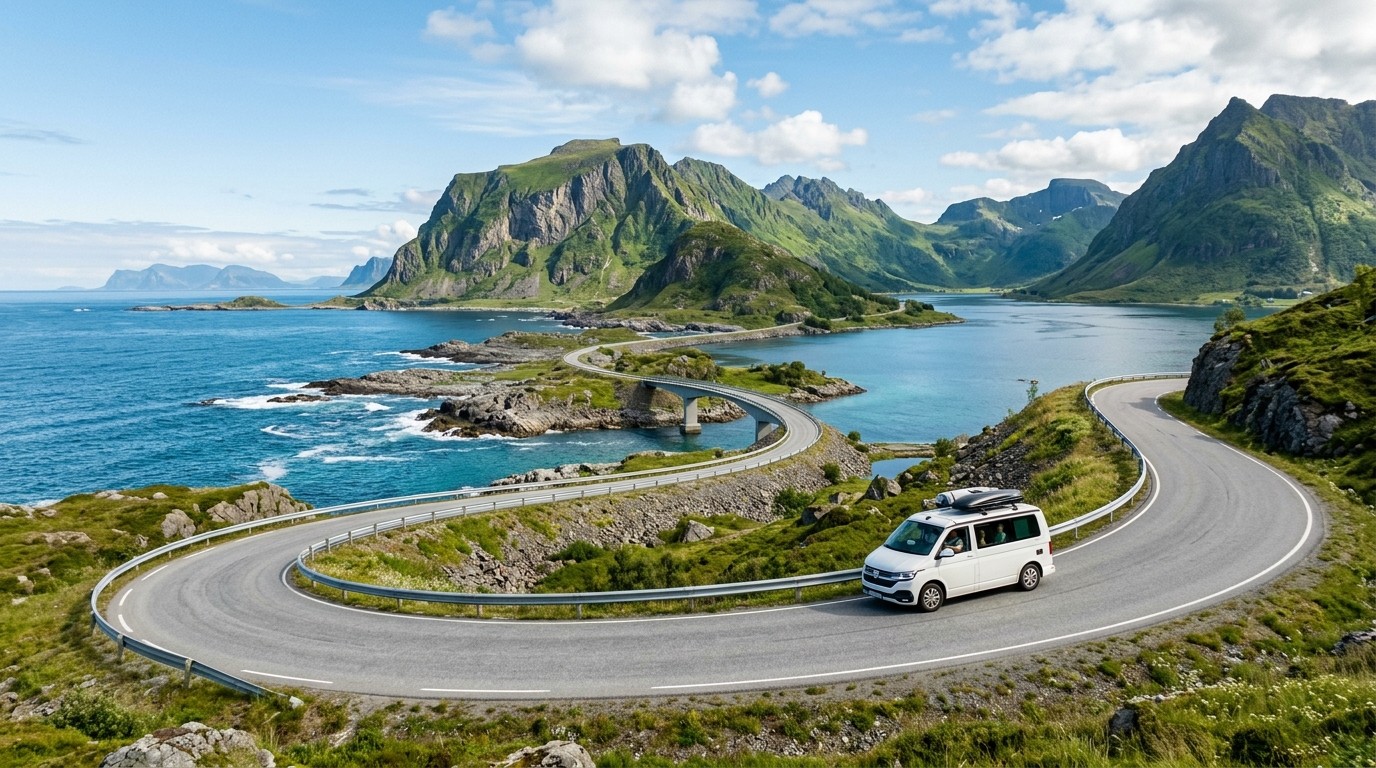
Timing can completely change your experience. Summer offers long daylight hours, easier access to many mountain roads, greener valleys, and greater flexibility for sightseeing. However, peak season can also bring more traffic, higher accommodation demand, and queues on popular ferry routes.
Norway Road Trip Tips for summer travelers are simple: book strategically and start early. Popular routes become noticeably busier later in the day, especially around famous viewpoints and ferry terminals.
Norway Road Trip Tips for shoulder-season travelers involve greater flexibility. Spring and autumn can provide quieter roads and beautiful landscapes, but snow and icy conditions may affect mountain routes.
Norway Road Trip Tips for winter road trips require a much higher level of preparation. Road conditions can become difficult, braking distances increase on slippery surfaces, and some mountain routes may close. Norway’s official tourism guidance advises checking traffic, weather, icy-road forecasts, tunnel status, and mountain-pass conditions before driving.
Lofoten is a particularly good example of seasonal planning. The Norwegian Scenic Route Lofoten is approximately 230 kilometers, but detours and stops can make the area worth exploring for several days or even a week. Official guidance notes heavier traffic during peak summer and warns that winter conditions can be challenging enough that the route is recommended only for drivers experienced with winter driving.
Renting a Car in Norway
Rental-car selection matters more than many first-time visitors expect. You do not necessarily need a huge SUV for a standard Norwegian road trip, but comfort, luggage capacity, tire suitability, and driving confidence matter.
Norway Road Trip Tips recommend choosing a vehicle that you can comfortably control on narrow roads. A very large vehicle can feel impressive when parked, but on a single-lane mountain road or tight village street, additional width can make driving more stressful.
Norway Road Trip Tips also emphasize checking the rental agreement before booking. Understand whether the vehicle is permitted on ferries, whether one-way fees apply, what insurance coverage includes, and how roadside assistance works.
Norway Road Trip Tips become particularly important for travelers bringing sports equipment or large luggage. A compact car can be economical, but if passengers have large bags, insufficient storage can make every day frustrating.
What to Check Before Picking Up the Car
Take a few minutes before leaving the rental location to confirm:
- Existing exterior damage is documented.
- The fuel or charging arrangement is understood.
- The emergency number is saved.
- The parking and toll process is explained.
- The tire setup is appropriate for the season.
- Navigation is available, preferably with offline capability.
- Charging cables are included if you rented an EV.
- The car’s dimensions feel comfortable to you.
Norway Road Trip Tips also suggest practicing basic controls before entering a remote area. Understand headlights, windshield controls, parking brake, driver-assistance systems, and the vehicle’s charging or refueling process.
Understanding Norwegian Roads
Driving in Norway can feel calm compared with many larger European destinations, but rural roads demand concentration. Outside urban areas, roads can become narrow and winding, with designated passing places rather than conventional wide shoulders. Official tourism guidance notes that many rural roads are single-lane and typically have speed limits around 60–80 km/h, while larger roads can have higher posted limits.
Norway Road Trip Tips emphasize that the posted speed limit is not a target you must maintain at all times. Weather, visibility, traffic, road geometry, and surface conditions should determine your actual speed.
Norway Road Trip Tips become critical when following a slow-moving vehicle. Use designated passing areas rather than attempting aggressive overtakes.
Norway Road Trip Tips also remind drivers to stay calm when local traffic appears behind them. Pull over safely where appropriate and allow faster traffic to pass rather than becoming anxious and accelerating beyond your comfort level.
Norway’s road culture rewards patience. You are there to see the landscape, not to prove how quickly you can reach the next destination.
Speed and Driving Awareness
Norwegian speed limits vary by road and location. Urban areas may have lower limits, while certain major roads and motorways have higher limits. Some dual carriageways can reach 110 km/h, but travelers should always follow the actual posted limit and adjust downward for conditions.
Norway Road Trip Tips should always include the principle of driving below the posted limit when conditions require it.
That is particularly important during rain, fog, snow, darkness, or narrow mountain sections.
Ferries Are Part of the Road Trip
One of the most distinctive elements of driving in Norway is that ferries are sometimes a natural continuation of the road rather than a completely separate travel activity.
Norway Road Trip Tips encourage travelers to think of ferries as part of the itinerary itself. A ferry crossing can provide a short break from driving and another perspective on the surrounding fjord landscape.
Norway Road Trip Tips should include checking ferry schedules before committing to a tight daily schedule. Waiting for the next departure can affect your arrival time, especially during busy periods.
Norway Road Trip Tips are particularly relevant during summer, when popular ferry connections can experience queues. Visit Norway notes that advance booking is recommended for some popular routes, including Geiranger–Hellesylt and Lauvvik–Lysebotn in Fjord Norway.
Many Norwegian ferries use automated payment systems, with AutoPASS being a major method for toll and ferry collection. FerryPay also allows payment by credit or debit card on participating journeys.
Ferry Strategy for Beginners
Instead of treating a ferry as an inconvenience, plan around it.
Check:
- Departure times.
- Whether reservations are possible.
- Whether your route has multiple alternative crossings.
- Whether queues are common.
- Whether the journey is essential to reaching your accommodation.
- Where you can wait comfortably.
- Whether your rental vehicle’s ferry process has any special requirements.
Once you become comfortable with ferry crossings, the Norwegian road-trip experience becomes much more fluid.
Road Tolls and Travel Costs
Norway is not the destination to choose if you want a completely predictable road budget. Fuel, accommodation, dining, parking, tolls, ferries, and activities can add up quickly.
Norway Road Trip Tips should therefore include a dedicated transportation budget rather than simply calculating the rental-car rate.
Norway has many automatic toll stations, and drivers generally have to pay Norwegian road tolls regardless of nationality.
Your rental-car company may have a system for handling toll charges, so ask how billing works before leaving the depot.
Norway Road Trip Tips also recommend checking parking costs in cities and major attractions. Free parking can be limited in busy areas, and parking rules may be strictly enforced.
Norway Road Trip Tips should include fuel planning as well. Official tourism guidance warns that petrol stations can be widely spaced in mountainous and remote regions, particularly in Northern Norway.
A good habit is to refill whenever your tank reaches a comfortable level rather than waiting until you are nearly empty.
Electric Vehicle Road Trips in Norway
Norway has an exceptionally strong EV culture, making electric rentals an increasingly attractive option for road trips. However, an EV trip still requires planning.
Norway Road Trip Tips for EV drivers start with route awareness. Do not assume every scenic village, mountain road, or remote attraction will have an immediately available charger.
Norway Road Trip Tips recommend treating charging stops as itinerary opportunities. Charge while eating lunch, exploring a town, visiting a museum, or taking a short walk.
Norway Road Trip Tips also suggest maintaining a sensible charging buffer in remote areas. Mountain driving, cold weather, elevation changes, and cabin heating can influence energy consumption.
For a relaxed journey, do not plan to arrive at a remote charger with only a tiny battery reserve.
Bergen : The Perfect Starting Point
Bergen is one of the strongest starting points for a western Norway road trip because it provides city culture before you enter the fjord region.
Begin with a relaxed exploration of the historic waterfront, local neighborhoods, viewpoints, and food scene before collecting your rental car.
Norway Road Trip Tips suggest avoiding the mistake of collecting a car immediately after a long international flight. If you are tired, spend a night in Bergen first.
From Bergen, you can branch toward Hardangerfjord, Sognefjord, Voss, Flåm, or the Fjord Coast.
The Fjord Coast and Sunnfjord area, for example, is roughly two to three hours north of Bergen and combines fjord landscapes, waterfalls, islands, coastal communities, and the scenic Gaularfjellet route.
Norway Road Trip Tips become especially effective when you use Bergen as a launchpad rather than simply a quick overnight stop.
Sognefjord : The Grand Scale Experience
Sognefjord is among the destinations where photographs often fail to communicate scale. The water extends beneath enormous mountains, and the surrounding landscape changes continuously as roads cross valleys and approach smaller fjord branches.
Norway Road Trip Tips for Sognefjord involve resisting the urge to see everything in one day.
Choose a base and explore slowly.
Villages around the fjord can become excellent overnight stops, allowing you to experience quieter evenings after day-tripping visitors have moved on.
Norway Road Trip Tips also suggest combining driving with boat travel when it improves the experience. Norway’s transport network includes ferries and express boats that connect fjord destinations, offering another way to experience the landscape.
Flåm can be incorporated into a road trip for travelers interested in combining road travel with one of Norway’s most famous railway experiences. The area also connects with fjord cruises and scenic landscapes.
Geirangerfjord and the Dramatic Mountain Roads
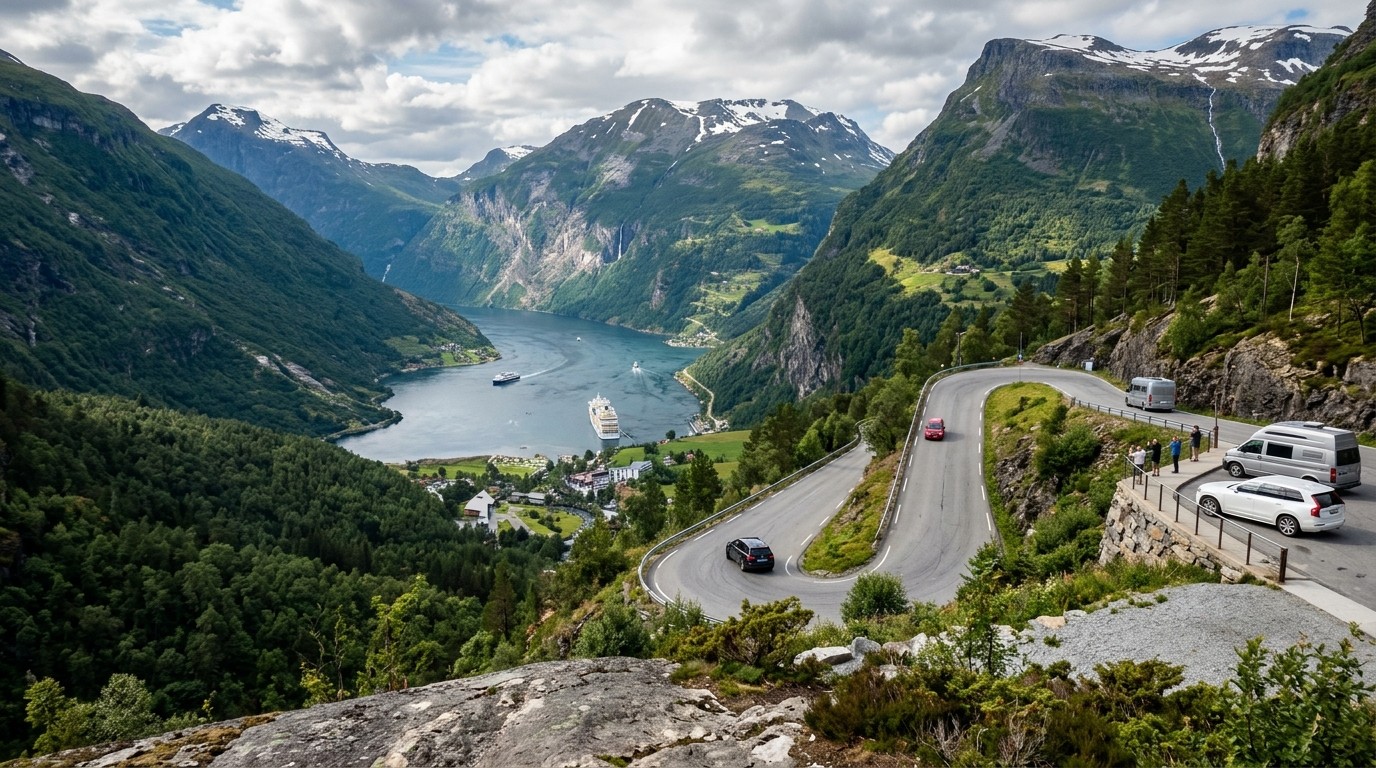
Geiranger is one of the most recognizable fjord destinations in Norway, and reaching it can be an attraction in itself.
Norway Road Trip Tips for the Geiranger region emphasize time. Do not build a schedule that allows only enough time to drive through, take one photograph, and leave.
Norway Road Trip Tips become especially valuable on the Geiranger–Trollstigen Scenic Route because the road contains hairpin bends, waterfalls, mountain landscapes, viewpoints, and a ferry crossing.
The official Norwegian Scenic Route Geiranger–Trollstigen stretches approximately 104 kilometers between Åndalsnes and Geiranger, including the Eidsdal–Linge ferry connection. Visit Norway recommends staying several days in the area rather than treating it as a simple one-day drive.
Norway Road Trip Tips therefore suggest building at least one flexible overnight around this region.
Allow time for viewpoints, short walks, unexpected stops, weather changes, and simply sitting beside the fjord.
Ålesund : Architecture Meets the Coast
Ålesund gives a fjord-focused road trip a valuable urban change of pace.
After several days of mountains and rural roads, arriving in a compact coastal city can feel refreshing. Explore its architecture, harbor, food scene, and surrounding viewpoints.
Norway Road Trip Tips suggest using cities as rest points rather than treating every overnight location as another sightseeing competition.
A relaxed evening in Ålesund can give you time to reorganize your luggage, charge devices, review the next route, and enjoy dinner without immediately returning to the car.
Lofoten : The Road Trip for Photographers
Lofoten feels almost unreal. Sharp mountains rise from the sea, fishing villages occupy tiny coastal spaces, and roads connect beaches, bridges, islands, and dramatic viewpoints.
Norway Road Trip Tips for Lofoten should focus on patience. You may expect to drive continuously, but the region encourages constant stopping.
The official Scenic Route Lofoten runs between Å and Raftsundet and includes possibilities to detour toward places such as Nusfjord, Vikten, Utakleiv, Unstad, Eggum, Henningsvær, and Grunnfør.
Norway Road Trip Tips also highlight the importance of respecting narrow roads. Use passing places when necessary, drive considerately, and allow local traffic to move freely.
Norway Road Trip Tips become even more important during peak season because the E10 can experience heavy car and motorhome traffic.
Instead of trying to cover the entire archipelago in two days, spend several nights and explore side roads and villages.
Scenic Routes You Should Know
Norway’s Scenic Routes program includes 18 designated routes that combine roads with viewpoints, architecture, rest areas, and cultural landscape experiences.
Norway Road Trip Tips should include these routes because they provide a useful framework for building a scenic itinerary.
However, do not confuse a Scenic Route with a race track.
Norway Road Trip Tips emphasize stopping responsibly. Pull into designated viewpoints and parking areas instead of stopping suddenly beside a narrow road to take photographs.
Norway Road Trip Tips also encourage travelers to explore route facilities. Some scenic stops feature unusually designed viewing platforms, architecture, artwork, and rest facilities.
The road becomes part attraction, part transport system, and part landscape experience.
Where to Stay During a Norway Road Trip
Accommodation is one of the most important factors in determining how enjoyable a road trip becomes.
Norway Road Trip Tips recommend mixing accommodation types rather than staying exclusively in standard city hotels.
Consider:
- Fjord-side hotels.
- Traditional cabins.
- Farm stays.
- Guesthouses.
- Small local hotels.
- Campsites.
- Apartment-style accommodation.
Norway Road Trip Tips also suggest booking the most strategically located nights first. A memorable fjord-side property or accommodation near a major route can transform the experience.
At the same time, avoid changing hotels every single night. Constant packing can become exhausting.
Two nights in one location often allow you to enjoy the region without feeling like you are constantly checking in and out.
What to Pack for a Norwegian Road Trip
Norway’s landscapes can tempt travelers into bringing specialized outdoor gear, but a practical packing system is more useful.
Norway Road Trip Tips suggest packing layers because weather conditions can change throughout the day.
A useful combination includes:
- Waterproof outer layer.
- Warm mid-layer.
- Comfortable walking shoes.
- Spare socks.
- Lightweight daypack.
- Sunglasses.
- Reusable water bottle.
- Portable charger.
- Offline maps.
- Car phone mount.
- Basic first-aid supplies.
- Small flashlight.
- Reusable shopping bag.
Norway Road Trip Tips also encourage keeping an emergency layer in the vehicle even during warmer months if you plan to hike or travel through mountain terrain.
Norway Road Trip Tips become particularly important when traveling outside major towns because convenience stores and equipment shops may not be immediately available.
Photography Without Ruining the Drive
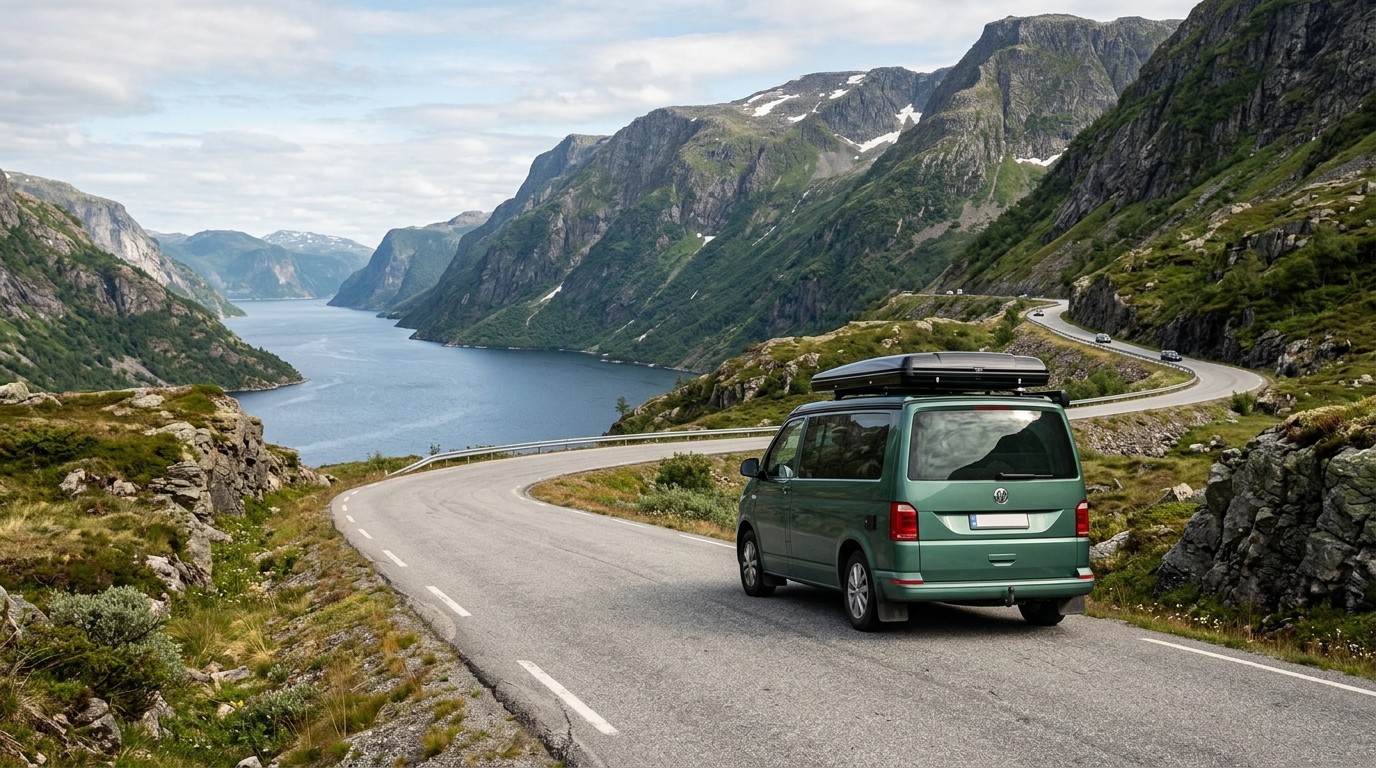
Norway is one of those destinations where you can feel the urge to stop every five minutes.
That is understandable.
But taking photographs should never override road safety.
Norway Road Trip Tips recommend using marked parking and viewpoint areas whenever possible. Official winter-driving guidance specifically warns drivers not to stop in the middle of the road for photographs and advises using designated safe stopping areas.
Norway Road Trip Tips also encourage using a passenger as the photographer when traveling with someone. Solo drivers should wait until the vehicle is safely parked before handling cameras or phones.
Norway Road Trip Tips are especially useful on narrow roads because even a few seconds of distraction can create unnecessary danger.
The best photographs usually come when you stop properly, step outside, and enjoy the landscape rather than trying to capture everything through the windshield.
Hiking During a Road Trip
Road trips and hiking naturally complement one another in Norway.
You can drive for several hours, park near a trailhead, hike for an hour or two, and continue toward your next destination.
Norway Road Trip Tips suggest being realistic about hiking ambitions. A physically demanding trail after several hours behind the wheel may not be enjoyable.
Choose hikes based on weather, fitness, daylight, terrain, and remaining driving time.
Norway Road Trip Tips also suggest informing someone of your hiking plans when entering less-traveled areas. Keep your phone charged and carry enough water.
Experienced international hikers may already be familiar with the planning mindset used for an Inca Trail Trek Guide or the terrain preparation commonly discussed in a Dolomites Hiking Guide. Norway requires the same fundamental discipline: understand the route, respect weather, use appropriate equipment, and avoid underestimating the environment.
The difference is that Norwegian scenery can make relatively ordinary walks feel so beautiful that travelers are tempted to continue farther than planned.
Know when to turn around.
Solo Norway Road Trip Tips
Driving Norway alone can be incredibly rewarding, but the solo experience requires additional planning.
Norway Road Trip Tips for solo travelers should begin with realistic driving distances. Six hours behind the wheel can feel very different when you are the only person navigating, checking weather, organizing stops, and managing luggage.
Norway Road Trip Tips suggest dividing long drives into manageable sections. Stop regularly, drink water, stretch, and use viewpoints as natural breaks.
A solo traveler should also avoid becoming too dependent on a single device. Keep offline maps available and maintain enough phone battery for emergencies.
Norway Road Trip Tips also encourage regular communication with someone at home. A simple daily message can provide reassurance without turning the trip into a scheduled reporting exercise.
For travelers accustomed to urban independent adventures such as Solo Travel New York City, Norway introduces a different kind of independence: managing distance, weather, roads, and remote landscapes rather than navigating dense urban environments.
That difference is precisely what makes the trip so rewarding.
Norway Road Trip Tips for Couples
Couples can make Norway road trips wonderful, but the confined environment of a car can also expose small frustrations.
Norway Road Trip Tips recommend dividing responsibilities. One person can drive while the other handles navigation, reservations, ferry schedules, music, photography, and food planning.
Do not assume that both travelers will want the same pace every day.
One person may want a long hike while the other prefers a quiet café or scenic viewpoint.
Norway Road Trip Tips encourage building personal downtime into the itinerary. A short solo walk or separate activity can make a long road trip feel more relaxed.
Avoiding the Most Common Road-Trip Mistakes
The most common mistakes are not dramatic. They are planning errors.
Mistake 1: Packing Too Many Stops Into One Day
Norway looks compact on digital maps, but road conditions, ferries, and scenic stops change the reality.
Mistake 2: Treating Google Maps Driving Time as the Entire Experience
Navigation estimates may not account for the number of places you will want to stop.
Mistake 3: Ignoring Ferry Timetables
A missed ferry can disrupt an entire day.
Mistake 4: Choosing Accommodation Only by Price
The cheapest property can become expensive if it requires long daily drives.
Mistake 5: Driving Too Fast on Scenic Roads
Safety and enjoyment are more important than shaving minutes off a journey.
Mistake 6: Assuming Summer Means Perfect Weather
Rain and sudden weather changes remain part of the Norwegian experience.
Mistake 7: Starting Every Day With a Huge Drive
Your holiday should contain experiences, not just transportation.
Mistake 8: Leaving Fuel or Charging Until the Last Moment
Remote regions may have fewer stations.
Norway Road Trip Tips work best when they are used to remove friction rather than add anxiety.
A Sample 10-Day Norwegian Fjord Road Trip
The following itinerary is designed as a flexible framework rather than a rigid schedule.
| Day | Route | Main Experience | Overnight |
|---|---|---|---|
| 1 | Bergen | City exploration | Bergen |
| 2 | Bergen → Voss | Waterfalls and valleys | Voss |
| 3 | Voss → Flåm | Fjords and scenic landscapes | Flåm |
| 4 | Flåm → Sognefjord area | Fjord exploration | Sognefjord |
| 5 | Sognefjord → Olden/Loen | Mountains and water | Olden/Loen |
| 6 | Olden → Geiranger | Scenic mountain drive | Geiranger |
| 7 | Geiranger area | Viewpoints and fjord | Geiranger |
| 8 | Geiranger → Ålesund | Coastal landscapes | Ålesund |
| 9 | Ålesund area | City and nearby scenery | Ålesund |
| 10 | Return/Departure | Flexible buffer | — |
Norway Road Trip Tips suggest adding buffer time if possible. The itinerary above is intentionally slower than a maximum-speed route because the most memorable moments often happen between major destinations.
Norway Road Trip Tips also encourage travelers to rearrange the sequence based on weather. A clear day can be prioritized for scenic mountain roads, while a rainy day may become ideal for museums, cafés, town exploration, or longer ferry journeys.
How to Make the Trip Feel Less Like a Checklist
A road trip becomes memorable when you stop measuring success by the number of attractions completed.
Norway Road Trip Tips encourage travelers to create experience categories instead:
One spectacular viewpoint.
One local meal.
One quiet village.
One scenic ferry.
One memorable hike.
One slow morning.
One unexpected stop.
Norway Road Trip Tips also suggest leaving empty space in the itinerary. When every hour is pre-booked, the road itself stops being part of the adventure.
The best road trips usually contain moments that were never planned.
Maybe you see a waterfall beside the road.
Maybe a village looks beautiful in evening light.
Maybe you discover a tiny bakery.
Maybe rain creates mist around the mountains.
Maybe you decide to stay one extra hour beside the fjord.
Those moments are the real reason to drive.
Responsible Travel in Norway
Norway’s natural beauty is also its most fragile asset.
Norway Road Trip Tips should include responsible tourism because large numbers of visitors can place pressure on popular trails, parking areas, roads, waste systems, and local communities.
Never block roads for photographs. Use designated parking areas. Follow local signs. Take waste with you when required. Respect private property and local communities.
Norway Road Trip Tips also mean remembering that some roads are essential local connections rather than tourist attractions. Drive considerately and make space for residents.
This is particularly important on narrow scenic roads where tourism traffic can interfere with everyday transportation.
Responsible driving makes the experience better for everyone.
How to Handle Bad Weather
Rain is not a failed Norwegian vacation. In the fjord regions, changing weather can actually add atmosphere to the landscape.
Norway Road Trip Tips suggest having an indoor alternative for each major area. A museum, local café, cultural attraction, town walk, or scenic boat journey can become your backup activity.
Norway Road Trip Tips also recommend checking weather and road conditions immediately before departure rather than relying only on a forecast you checked the previous evening.
In winter, this becomes essential. Official guidance advises checking road and traffic information and weather forecasts, adapting speed to conditions, and recognizing that icy roads significantly increase braking distances.
Never allow a sightseeing plan to become more important than road conditions.
Emergency Preparedness
You probably will not need an emergency plan, but creating one takes very little effort.
Keep your rental company contact information accessible.
Save accommodation details offline.
Know where your passport and insurance information are stored.
Keep your phone charged.
Tell someone your general route.
Norway Road Trip Tips also encourage travelers to understand how roadside assistance works before leaving the rental location.
If your vehicle breaks down, prioritize personal safety over protecting the itinerary. Get to a safe position, follow the rental company’s procedures, and use official assistance channels.
Norway Road Trip Tips should make you more confident, not reckless. Preparation allows you to enjoy remote landscapes without pretending that distance and weather do not matter.
How to Combine Norway With Other Travel Experiences
Norway can easily form part of a larger European trip.
You might begin in a major European capital, fly into Bergen, complete a fjord road trip, and then continue toward another destination.
Travelers interested in several different kinds of adventure could use Norway as the scenic road-trip chapter of a broader itinerary. A city-focused journey such as Solo Travel Hawaii or Solo Travel New York City offers a very different pace, while a hiking-centered experience such as the Inca Trail Trek Guide or a Dolomites Hiking Guide represents a more physically focused travel style.
The point is not to combine everything into one trip.
The point is to recognize how Norway’s road-trip experience fits into a broader travel identity.
Norway gives you freedom, but the landscapes naturally encourage slower movement.
Norway Road Trip Tips for a More Affordable Journey
Norway can be expensive, but thoughtful planning can control the biggest costs.
Choose accommodation with kitchen facilities when practical.
Buy snacks and breakfast supplies from supermarkets.
Use a reusable water bottle.
Limit unnecessary city-center parking.
Compare accommodation locations rather than looking only at headline prices.
Norway Road Trip Tips also encourage travelers to prioritize paid experiences. You do not need to book an expensive attraction every day when the landscapes themselves provide countless free experiences.
Many scenic viewpoints, walks, beaches, villages, and road stops can become highlights without requiring admission fees.
The biggest savings often come from avoiding unnecessary driving.
A route that reduces fuel, tolls, parking, and ferry expenses can be more effective than cutting a few euros from accommodation.
Final Planning Checklist
Before departing, confirm that your route is realistic.
Documents and Bookings
- Passport and required travel documents.
- Driving license accepted for your rental arrangement.
- Rental-car confirmation.
- Accommodation confirmations.
- Travel insurance documentation.
- Ferry reservations where appropriate.
- Payment cards and backup payment method.
Navigation
- Offline maps.
- Official road information.
- Ferry schedules.
- Weather forecast access.
- Accommodation addresses saved.
- Emergency contact information.
Vehicle
- Fuel or charging plan.
- Tire suitability.
- Insurance understanding.
- Rental-company emergency number.
- Phone mount.
- Charging cables where applicable.
Daily Routine
- Check weather before leaving.
- Check road conditions.
- Check mountain-pass status.
- Check ferry departures.
- Keep enough fuel or charge.
- Plan photo stops safely.
- Leave buffer time.
Visit Norway points travelers toward the Norwegian Public Roads Administration for live traffic information, ferry timetables, forecasts for slippery roads, mountain-pass opening status, and tunnel information.
The Perfect Norway Road Trip Mindset
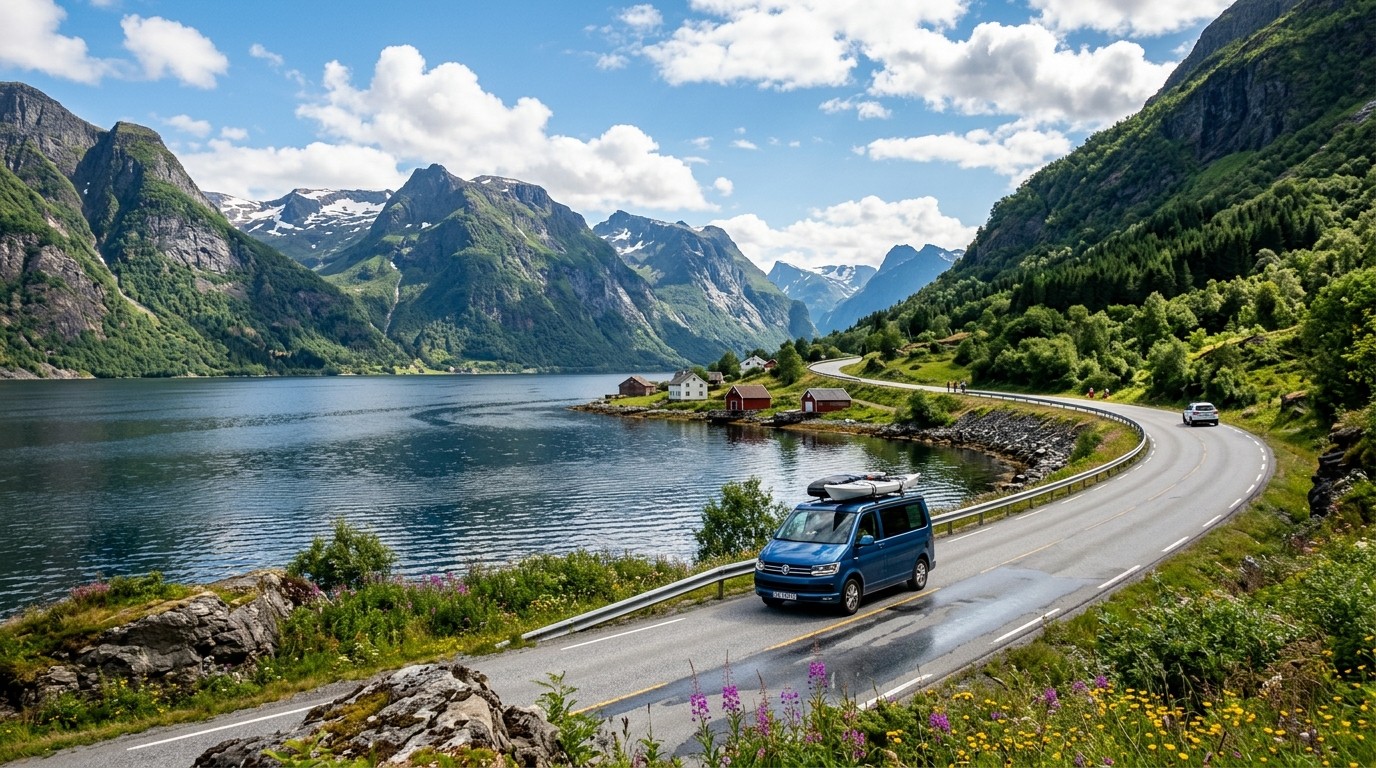
The greatest Norway road trip is not necessarily the longest one.
It is the one where you remember the silence.
The first glimpse of a fjord.
The sound of rain against a cabin window.
The curve of an empty road through the mountains.
A ferry crossing beneath towering cliffs.
A small village where you stopped without planning.
A roadside waterfall that made everyone pull over.
Norway Road Trip Tips are ultimately about creating the conditions for those moments to happen.
Do not over-schedule.
Do not underestimate the roads.
Do not ignore the weather.
Do not rush through scenic regions.
Do not treat ferries as problems.
Do not forget that local communities use these roads every day.
And most importantly, do not turn an extraordinary landscape into a race against the clock.
Norway Road Trip Tips work best when they encourage you to slow down enough to actually see Norway.
Conclusion
A Norwegian road trip is an adventure where every kilometer can become part of the destination. The secret is not trying to cover the most ground, but choosing the right region, allowing realistic driving times, checking road and weather conditions, understanding ferries and tolls, and leaving room for unexpected discoveries. From Bergen and Sognefjord to Geiranger, Ålesund, and Lofoten, Norway offers extraordinary combinations of mountains, water, villages, waterfalls, and scenic roads. Plan carefully, drive patiently, respect local conditions, and embrace a slower rhythm. When transportation becomes part of the experience rather than an obstacle, chasing Nordic fjords becomes the kind of journey you remember long after returning home.
Frequently Asked Questions (FAQ)
1. How many days are ideal for a Norway road trip?
For a first-time fjord-focused journey, around 7–10 days can provide a good introduction. Longer trips of 10–14 days allow you to reduce daily driving and explore additional areas.
2. What is the best month for a Norway road trip?
Summer generally offers long daylight hours and easier access to many routes, while spring and autumn can provide quieter conditions. Winter requires much more experience with difficult driving conditions.
3. Is driving in Norway difficult?
It is manageable for confident drivers, but rural roads can be narrow, winding, and steep. Mountain weather, ferries, tunnels, and variable road conditions require patience and attention.
4. Do I need a 4×4 for a Norway road trip?
Not necessarily. A standard rental car can handle many popular routes. The appropriate vehicle depends on the season, route, weather, road conditions, and your personal driving confidence.
5. Are Norwegian roads expensive to use?
Road travel can involve tolls, fuel, parking, and ferry expenses. Most toll stations are automatic, and all drivers are generally responsible for Norwegian road tolls.
6. Are ferries necessary on Norwegian road trips?
Some routes include ferry crossings as a normal part of the road network. They can be essential for connecting fjord communities and scenic areas, so checking timetables is an important part of route planning.
7. Can I drive around Norway in winter?
Yes, but winter driving requires additional preparation and experience. Icy roads, snow, reduced visibility, and closed mountain passes can make some routes challenging. Official guidance recommends checking live road conditions and weather before every drive.
8. Is Lofoten good for a road trip?
Absolutely. The Scenic Route Lofoten combines dramatic mountains, beaches, fishing villages, fjords, and coastal scenery. The full route is about 230 kilometers, but detours and stops justify several days of exploration.
9. Can I do a Norway road trip alone?
Yes. Solo road trips can be highly rewarding, but you should plan realistic driving distances, maintain communication with someone at home, keep your phone charged, and avoid taking unnecessary risks in remote areas.
10. What is the biggest mistake first-time Norway road trippers make?
The most common mistake is trying to do too much. Norway’s roads are part of the experience, so rushing between destinations can turn an incredible scenic journey into a tiring transportation schedule. Build fewer stops, longer stays, and flexible time into your plan.




Leave a Reply